Kalanchoe daigremontiana (Mother of Thousands)
A succulent plant from the Crassulaceae family
Characteristics
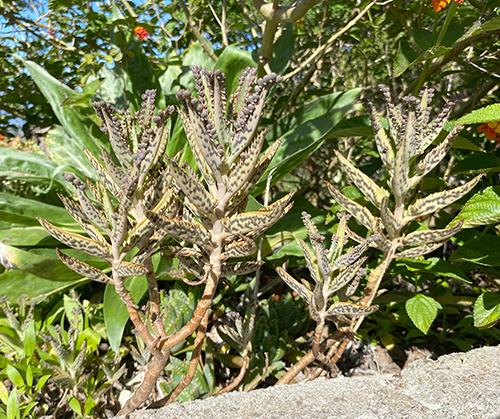
Small offshoots grow along the edges of the elongated leaves and fall off at the slightest touch. This is how the plant reproduces. Kalanchoe daigremontiana contains complex active compounds, including cardiotonic bufadienolides, which can be toxic but, when used properly, have great medicinal potential.
Location
A sunny to partially shaded location with well-drained soil is ideal. Kalanchoe daigremontiana requires little water and tolerates heat well.
How to use
After a few attempts to eat the leaves to experience their effects, we’ve become a bit more cautious. The leaves taste relatively good, but their effects were never consistent. It seems that each individual plant—even if it’s a Kalanchoe daigremontiana—contains very different amounts of various compounds. Sometimes eating a leaf had a strongly calming effect, and other times, the exact opposite.
Related species such as Kalanchoe pinnata (also known as the Goethe plant or Bryophyllum pinnatum) are more “consistent” in this regard if you wish to use them yourself. Kalanchoe pinnata is used in homeopathy and naturopathy (e.g., by Weleda) primarily in women’s health. In some clinics, it is also used to treat premature contractions.
Caution is advised with Kalanchoe daigremontiana due to its toxic components. However, it is gaining increasing medical significance as a herbal alternative and is now also being used, backed by scientific research, to treat herpes and promote wound healing. Of particular interest is its tumor-inhibiting effect on various types of cancer. Although this has so far only been demonstrated in the laboratory, it suggests that this plant could be a potential alternative to chemotherapy.
Observations
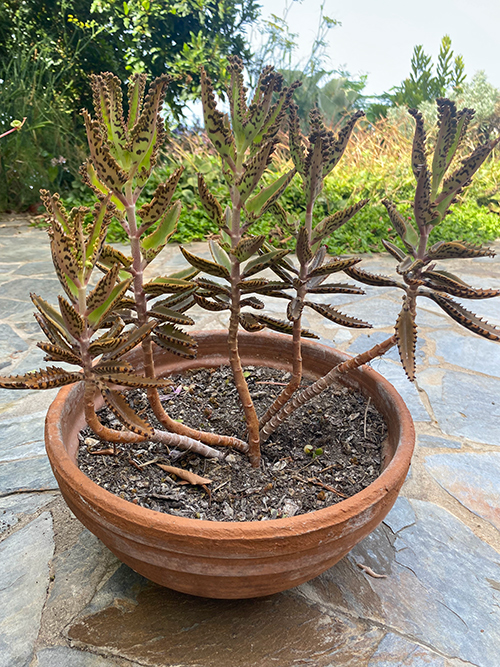
In theory, the seedlings that have fallen off should take root immediately. The plant is therefore classified as invasive. We cannot confirm this. After a wonderful bloom last year and a persistent presence in several locations, it is, for example, barely to be found at the time of this post’s publication. That’s why, just to be safe, we’ve also planted it in a pot. But we’re certain that we’ll soon be able to admire it again in many places throughout the grounds.
More names
In English, this plant is also called the “Alligator Plant” because of the jagged shape and often dark-spotted pattern of its leaves. Its coloration is reminiscent of an alligator’s skin. Other names include “Mexican Hat Plant” (due to the shape of the leaves, which, with the small plants arranged around them, resemble a Mexican sombrero) or “Devil’s Backbone,” referring to the bony and rigid-looking leaf structures.
The name “Mother of Millions” is incorrect in this context, as that refers to a different species, Kalanchoe delagoensis.