Mousehole tree (Myoporum laetum)
Provides wind protection even in salty air. Known as mousehole tree or ngaio
Characteristics
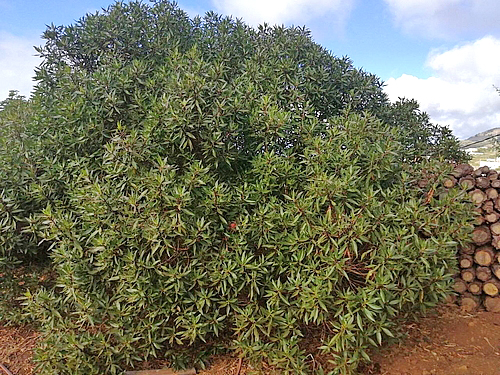
An evergreen shrub—and, more rarely, a tree—belonging to the figwort family (Scrophulariaceae). As a shrub, it typically grows to a height of 4–6 m. The leaves are slightly fleshy and dotted with resin glands. The Latin name Myoporum laetum is often translated as “joyful glandular plant,” although the translation “joyful” does not do justice to the Latin “laetum.” A more fitting translation here would be “lush” or “healthy.” For this shrub does indeed appear lush. Mousehole tree is a reference to the many small pores on the leaves. The name “Ngaio” comes from New Zealand, the plant’s country of origin.
Location
It prefers plenty of sun but will also grow in partially shaded areas. It has no special requirements regarding soil or watering. However, until it has grown a bit larger and established its roots, it should be watered regularly.
Uses
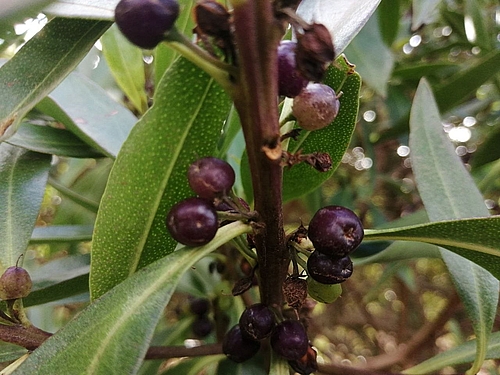
The leaves are poisonous, and ingesting them can cause liver damage in animals (horses, sheep, dogs) as well as in humans. This is due to the nagaione contained in the plant. Birds, on the other hand, have a different digestive system and happily eat the berries. It is said that the Maori used to rub the leaves on their skin to repel mosquitoes.
Propagation
Can be propagated via cuttings. And if you wait and look closely, you may also spot small offshoots near the parent plant.